Breeding animals – Tokay Gecko
A large, powerful and mainly nocturnal arboreal gecko from South and Southeast Asia, well known for its blue-grey body and orange to red spots.
Tokay Gecko – husbandry, breeding & our breeding animals
Here we introduce our Tokay Gecko breeding group (Gekko gecko). Alongside the individual breeding animals, you will find practical information about natural range, general husbandry, morphs or localities, genetics and our long-term breeding plans.
At JZ-Reptiles, we put a lot of value on well-documented reptile keeping and responsible breeding here in Austria. With Tokay Gecko, our focus is on traceable origins, healthy breeding animals and clear information about our lines.
No breeding animals have been published for this species yet.
Tokay Gecko Gekko gecko
Origin & natural range
Tokay geckos occur across parts of South and Southeast Asia, from north-eastern India and southern China through mainland Southeast Asia to many islands of the Malay Archipelago and Indonesia.
General husbandry
Tokay geckos need a tall, escape-proof and strongly structured enclosure with sturdy climbing surfaces, bark crevices and several sheltered retreats. Good ventilation, a natural humidity cycle with drying phases and suitable heat and UV zones are important. The species can be territorial and very defensive, so compatibility must be monitored closely.
Key parameters
General guide: keep a warm daytime gradient with a defined warmer area, allow a moderate night-time drop and use regular humidity cycles followed by drying. Good airflow, secure vertical structure and access to clean drinking water are important.
Space & enclosure
A tall enclosure with genuine usable width and depth is preferable to a narrow vertical box. Provide several climbing routes, bark or cork retreats and enough separation for animals to avoid one another when pair housing is attempted.
Diet
In the wild: Mainly insects and other invertebrates; large animals may occasionally take small vertebrate prey.
In human care: A varied selection of appropriately sized feeder insects such as crickets, roaches and locusts; gut-load feeders well and adjust mineral supplementation to age and breeding status.
Conservation & CITES
Conservation status: Gekko gecko is listed in CITES Appendix II. International trade and cross-border transfers are therefore subject to the relevant proof-of-origin and CITES documentation requirements.
Special notes & safety
Not venomous, but Tokay geckos are powerful and can deliver a painful bite. Direct handling should be kept to a minimum and enclosure work should be planned to avoid escapes and unnecessary stress.
The husbandry information and space recommendations on this page are general guidance. Legal minimum requirements vary between countries and regions and must always be checked locally. Before buying any animal, please take the time to learn about the species in depth – you are welcome to ask us, and we also recommend good specialist literature. Husbandry should always be adapted to the species, locality, age, size and individual animal.
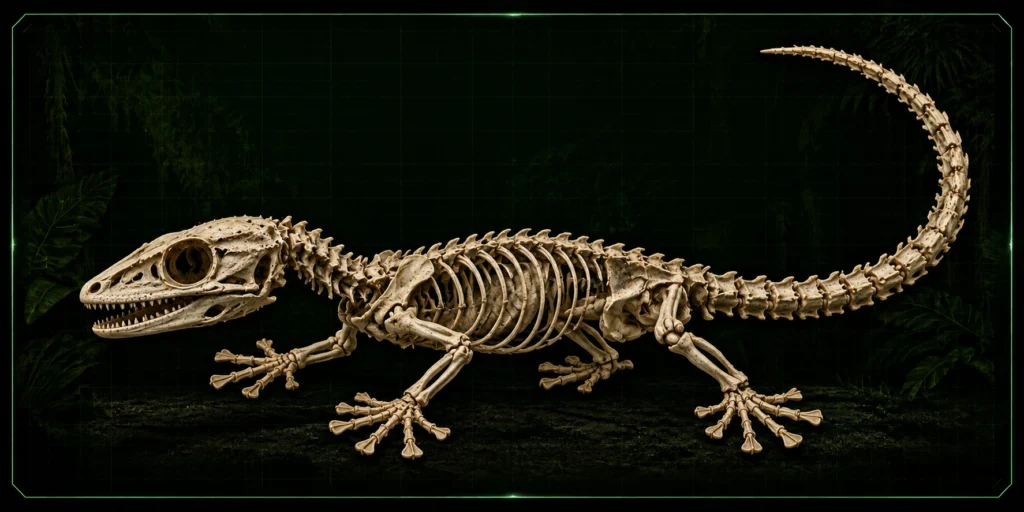
Skeleton of Tokay Gecko
Natural range

Frequently asked questions about the Tokay gecko
Where does the Tokay gecko come from?
The species occurs across parts of South and Southeast Asia, from north-eastern India and southern China through mainland Southeast Asia to many islands of the Malay Archipelago and Indonesia.
What is important when keeping a Tokay gecko?
Tokay geckos need a tall, escape-proof and highly structured enclosure with sturdy climbing surfaces, bark crevices and several sheltered retreats. Good ventilation, a natural humidity cycle with drying phases and suitable heat and UV zones are important. The species can be territorial and very defensive, so any pair or group housing needs close observation.
How should a Tokay gecko enclosure be structured?
Tokay geckos are powerful arboreal geckos. A tall, escape-proof enclosure with sturdy climbing surfaces, cork, bark crevices and several sheltered retreats provides useful structure.
What role do humidity and ventilation play for Tokay geckos?
The species needs an appropriate humidity cycle together with good airflow. Regular humid periods should be followed by drying rather than keeping the enclosure permanently wet.
Do Tokay geckos need heat and UV light?
A clear temperature gradient with suitable warm areas is an important part of husbandry, together with high-quality lighting. Appropriate UV provision can be integrated into a modern naturalistic setup.
Can Tokay geckos be kept as a pair?
Pair housing can work with compatible animals in a sufficiently structured enclosure, but it requires close observation. Tokay geckos are territorial and incompatible animals can injure one another.
What does a Tokay gecko eat?
Tokay geckos feed mainly on insects and other invertebrates. In human care they are offered a varied selection of appropriately sized feeder insects, with mineral supplementation adjusted to age and breeding status.
Where can I see JZ-Reptiles’ breeding animals of this species?
You can find our breeding animals and species information on the breeding animals page for Tokay gecko (Gekko gecko). See our breeding animals.
Do you currently have captive-bred Tokay gecko available?
You can see what is currently available on our animals-for-sale page. Availability changes throughout the breeding season and as individual animals develop. See what is available.
More from JZ-Reptiles: Animals currently available · FAQ