
Río Fuerte Beaded Lizard – offspring & available animals
Current Río Fuerte Beaded Lizard offspring and available animals from JZ-Reptiles, clearly organised by clutch. Where parent animals are known, they are linked directly so the background of each clutch stays easy to follow.
No animals are currently available
New offspring will appear here automatically as soon as they are published.
Río Fuerte Beaded Lizard available - captive-bred animals from JZ-Reptiles
If you are looking for Río Fuerte Beaded Lizard or want to see our current offspring, you will find the available animals here organised by clutch. Where the parents are known, we show them with the clutch so the origin, line and breeding goal stay easy to follow.
Each available Río Fuerte Beaded Lizard is listed with the important details such as sex, morph or locality, origin, status and photos. Available and reserved animals can be enquired about directly through the contact form or WhatsApp.
For Río Fuerte Beaded Lizard (Heloderma exasperatum), we show background on origin, husbandry and breeding, our own breeding animals and, when available, current offspring.
Río Fuerte Beaded Lizard Heloderma exasperatum
Origin & natural range
Native to north-western Mexico, especially southern Sonora and south-western Chihuahua around the Río Fuerte drainage.
General husbandry
Río Fuerte Beaded Lizards need a large, very secure terrestrial enclosure with warm and cooler zones, deep protected retreats, burrowing opportunities and seasonally appropriate moisture variation. Safe access and clear working procedures are essential.
Key parameters
General guide: provide a warm daytime gradient with a defined basking area, cooler deep retreats, burrow-friendly substrate and a seasonal moisture cycle rather than a uniformly hot and bone-dry setup.
Space & enclosure
Use a generous, very securely locked ground enclosure with several climate zones, deep retreats and enough room for normal exploring. This species is larger and more powerful than a Gila monster, so safe access and enclosure operation are especially important.
Diet
In the wild: Mainly eggs, nestlings and young vertebrates, plus small mammals, birds and reptiles.
In human care: Offer controlled portions of suitable whole prey and eggs at appropriate intervals; monitor body condition closely and avoid overfeeding.
Conservation & CITES
Conservation status: CITES Appendix II as Heloderma spp. (with the separately listed Appendix-I taxon excluded). Depending on the country, additional permits for venomous or potentially dangerous animals may also be required.
Special notes & safety
VENOMOUS. A bite can cause severe pain, swelling and systemic effects and must be treated as a medical emergency. Avoid direct handling; use secure tools, protected transfer methods and a clearly planned emergency procedure. Do not cut, suck or tightly bind the bite area.
The husbandry information and space recommendations on this page are general guidance. Legal minimum requirements vary between countries and regions and must always be checked locally. Before buying any animal, please take the time to learn about the species in depth – you are welcome to ask us, and we also recommend good specialist literature. Husbandry should always be adapted to the species, locality, age, size and individual animal.
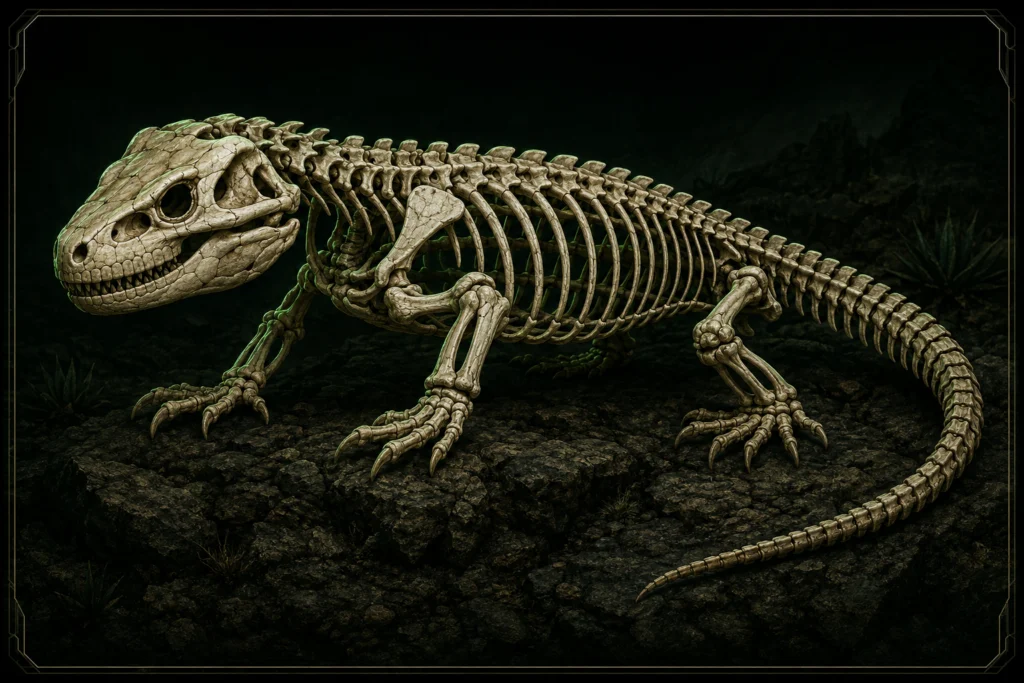
Skeleton of Río Fuerte Beaded Lizard
Natural range

Frequently asked questions about the Río Fuerte Beaded Lizard
Where does the Río Fuerte Beaded Lizard come from?
The Río Fuerte Beaded Lizard is native to north-western Mexico, especially southern Sonora and south-western Chihuahua around the Río Fuerte drainage.
What is important when keeping a Río Fuerte Beaded Lizard?
This venomous species requires specialist, legally compliant care in a highly secure terrestrial enclosure. A useful practical range for adults is around 21–25 °C in the cooler daytime zones with a 35–40 °C basking area; night temperatures can drop to about 17–20 °C. Deep secure retreats, burrowable substrate, humid microclimates and good ventilation are essential, with stronger seasonal misting rather than a constantly wet enclosure.
What temperatures does a Río Fuerte Beaded Lizard need?
A practical adult range is around 21–25 °C in the cooler daytime zones with a basking area of about 35–40 °C. At night the temperature can fall considerably; a successfully documented enclosure used roughly 17–20 °C at night. The key is a real thermal gradient so the animal can choose its preferred temperature.
What humidity and substrate moisture are appropriate?
A single constant enclosure-wide humidity target is less useful than a moisture gradient. Burrows and secure retreats should stay noticeably more humid while good ventilation prevents waterlogging. In one documented nest chamber, relative humidity was 87–94%; that high value applies to the humid nest microclimate, not the entire enclosure.
How deep should the substrate be?
The enclosure should include genuinely deep, stable and burrowable substrate. A successful zoo enclosure used depths of roughly 10–60 cm depending on the area, and the female selected nesting zones deeper than 20 cm.
Does the species benefit from seasonal climate changes?
Yes. Seasonal changes in light, temperature and moisture are useful. One documented husbandry system used a 14–16 hour photoperiod in summer and 10–12 hours in winter. More intensive misting during wetter periods can also encourage activity.
What safety requirements apply to a Río Fuerte Beaded Lizard?
As a venomous lizard, the species requires an especially secure, escape-proof enclosure and clearly planned working procedures. Safety and any applicable legal requirements must be clarified before keeping the species.
How should a Río Fuerte Beaded Lizard enclosure be structured?
A generous ground area, deep secure retreats, burrowing zones, sturdy rock or wood structures and clearly separated temperature and moisture zones are appropriate. Furnishings must not interfere with safe inspection and routine care.
Is a Río Fuerte Beaded Lizard suitable for beginners?
Because of its venom, size, safety requirements and specialised husbandry and working procedures, it is not a typical beginner species.
Where can I see JZ-Reptiles’ breeding animals of this species?
You can find our breeding animals and species information on the breeding animals page for Río Fuerte Beaded Lizard (Heloderma exasperatum). See our breeding animals.
Do you currently have captive-bred Río Fuerte Beaded Lizard available?
You can see what is currently available on our animals-for-sale page. Availability changes throughout the breeding season and as individual animals develop. See what is available.
More from JZ-Reptiles: Species profile & our breeding animals · FAQ